
Packrafting the Upper Red Deer River: A 4-day Traverse of Banff National Park's Backcountry

Updated: Feb 14

Why Packraft the Upper Red Deer?:
Born in the high peaks of Banff National Park, the Red Deer River flows through a broad valley with stunning mountain views and a good chance to see wildlife. Beginning in Lake Louise, one of Banff's most popular destinations, this route offers a great contrast between the bustle of the west side of the park and its remote, wilder east side. With excellent trail access and reliable flows, this run has become a destination for packrafters in the region. The Upper Red Deer is a great option for groups of mixed abilities, with some harder whitewater contained within short sections of canyon that can be easily portaged.
ROUTE OVERVIEW:
The route starts at Fish Creek Trailhead at the base of Lake Louise Ski Resort. Begin with 22km of hiking, following trails past Ptarmigan Lake and over Deception Pass before reaching the river's origin at Red Deer Lakes. The 54km paddling portion of the route begins with a steeper section cutting through intermittent canyons before the river's gradient decreases as it exits the alpine and enters the drier benchland of Alberta's ranching country.
Difficulty and Flow:
The Upper Red Deer is a Class II-III run with four canyons that contain significantly harder whitewater (IV-V+). The canyons are concentrated within the first third of the run, and all can be easily portaged via the river left trail or short bushwacks. If class III is your limit, the first two canyons will be certain portages, and some parties may consider hiking a few more kilometers to put-in below them. The run could also be done as an "out-and-back", hiking up from the bottom and putting in below the final waterfall of the 4th canyon for a class II+ trip. The Red Deer has reliable, lake-fed flows throughout the summer and fall. High spring flows warrant extra caution while approaching each canyon.
ROUTE DESCRIPTION:
The Hike (22km):
The route begins at Fish Creek Trailhead near the base of the Lake Louise Ski Resort. The first few kilometers of walking are along a gated access road that is a winter-time ski trail. After 3.5km, you leave the road grade and continue on a well-traveled and well-signed trail. This western side of the Banff backcountry gets more visitation, and you can expect to see lots of day hikers and guests hiking into Skoki for the first 12 km. You'll pass a few scenic alpine lakes and will be treated to nice views of the surrounding Slate and nearby Sawback Ranges from Deception Pass. Eventually, you branch off to the east before Skoki Lodge to continue to Red Deer Lakes, the source of the river, and the location of an established park campground. After staying a night at the campground, hike the remaining 5 km to near Shingle Flats, where the trail nears the river, and an additional tributary adds enough water to paddle.
Red Deer River:
Put-in through 1st Canyon (III-IV+):
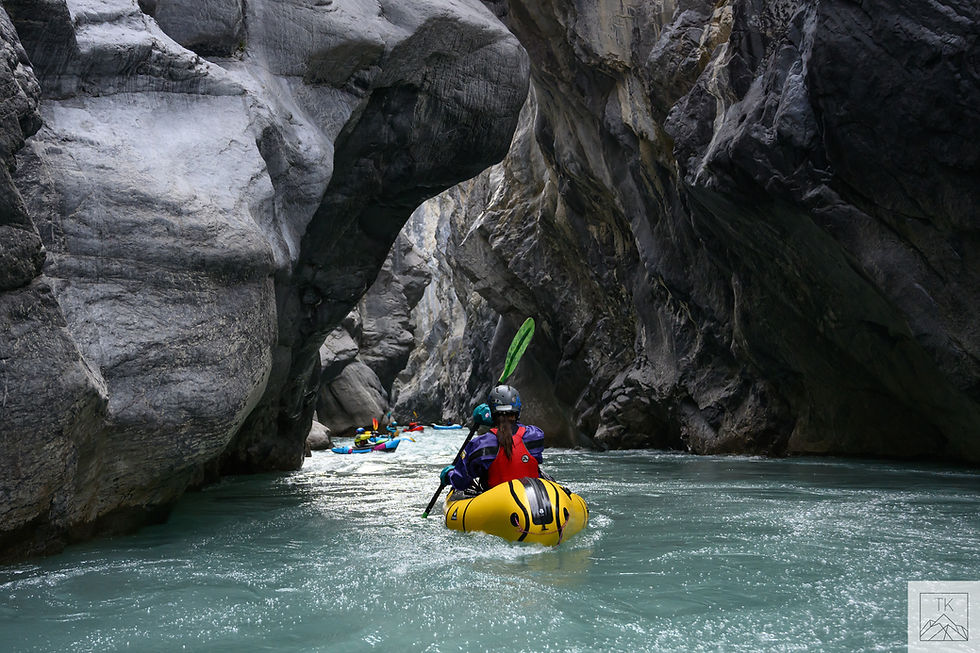
The whitewater starts immediately below Shingle Flats as the river enters a low-walled canyon with a few corners of class III. The first horizon line marks the start of a two-drop sequence separated by fast-moving water. The first looked runnable yet boat-abusive, while the second and bigger drop offered a clean, sloping boof of about 4-5 meters. Generally, portaging options for all of the Red Deer's canyons are easiest on river left, where the trail is never too far away.
Through the 2nd Canyon (II, portage):
Leaving the first canyon, the river opens into a broad meadow before passing through an oxbow lake. When you see the bedrock return, grab an eddy before the river drops over a falls and into a steep canyon. We portaged on river right, but it was evident that the river left was the better option. You can put in just below the final falls.
Through the 3rd Canyon (II-IV+):
Below the second canyon, there is a longer stretch of meandering paddling interspersed with the occasional class II, which allows you to relax and take in some big views of the Red Deer Valley. A cabin on river left signals that you are approaching the start of the 3rd canyon. As you enter the canyon, you are treated to the best sequence of whitewater on the run: a fun series of class III constricted between low walls. Don't let your guard down because the final rapid of this canyon is its crux with a sieve hazard at low flow and river wide hole that would pack a punch with more water. It can be scouted and portaged from an eddy just upstream on river left.
Through the 4th Canyon (II+/III-, portage):
Below the 3rd canyon, the river mellows but maintains a steady pace as it flows through alternating stretches of braids and meadows. There are many great camping options on gravel bars or vegetated benches throughout this section. After easy floating, the 4th Canyon starts with an optional, 2-meter, river-wide ledge that is worthy of a few laps. This feature also marks the start of the final portage to bypass a big and consequential falls known interchangeably as Knockout Falls or Hidden Falls. Portage along the river left rim of the canyon before finding a way to descend below the falls. There are a few more turns of excellent canyon scenery before the river opens up into a broad valley.
Below the Canyons (II+):
Below the Fourth Canyon, the river gradient lessens. While a few short canyons offer an occasional change in character, none of them contain any significant whitewater. There are lots of camping options throughout this section. At the park boundary, be on the lookout for fencing that is strung across the river to help manage the park's reintroduced bison herd. Most groups end their trip at Bighorn Campground.
LOGISTICS:
Permits:
This trip requires a permit from Banff National Park. For your first night, I'd recommend reserving Red Deer Lakes (Sk19), a maintained backcountry campsite with tables, a bear hang, and a latrine. For any remaining nights, book as "Lower Red Deer Random". "Random Camping" allows you to find low-impact camping within the park outside of designated sites. We found a 3-night trip to be a comfortable length that allowed for a leisurely pace and some side-hiking.
Shuttle:
The one downside of this route is it's a 3.5-hour drive from the takeout at Bighorn Campground to the trailhead at Fish Creek. Thankfully, some friends in Canmore were able to help us with the shuttle after joining us for a day paddle on one of the Lower Red Deer's popular roadside sections (Mountain Aire to Cache Hill). Check with outfitters in Canmore or Banff for shuttle services if you have just one vehicle or want to avoid an extra day of driving.

Comments